The Future Homes Standard (FHS) is the 2026 update to Part L (Conservation of Fuel and Power) of the Building Regulations for England, published in March 2026. It requires all new homes to produce at least 75% lower carbon emissions than homes built to the 2013 standards, effectively mandating heat pumps, solar PV, and significantly improved building fabric.
The FHS was first consulted on in October 2019, with a further consultation in 2023 setting out the detailed technical requirements. The government response and final Approved Documents were published on 24 March 2026, with the regulations coming into force on 24 March 2027. Compliance is demonstrated using the Home Energy Model (HEM) or SAP 10.3 during a transitional period.
Explore the Future Homes Standard
Part L Changes
U-values, fabric specs, and what the new Part L requires
Ventilation & Part F
Airtightness, mechanical ventilation, and commissioning under Part F
Overheating & Part O
Summer comfort, solar gains, and Part O compliance
Compliance Pathways
HEM vs SAP 10.3: which route and when
SAP 10.3 vs HEM
Side-by-side comparison of the two methodologies
Transitional Arrangements
Deadlines, plot registration, and strategies
Key Requirements at a Glance
The FHS introduces the most significant changes to new-build standards since Part L was last fundamentally updated. Here are the headline requirements:
75% Carbon Reduction
New homes must produce at least 75% less carbon emissions than homes built to the 2013 Part L baseline. This is a substantial step beyond the 2021 Part L uplift, which required a 30% reduction. The target is achieved through a combination of low-carbon heating, improved fabric performance, and on-site renewable generation.
Low-Carbon Heating
The FHS carbon targets are set at a level that fossil fuel heating cannot meet. In practice, this means:
- Air source heat pumps (ASHPs) or ground source heat pumps (GSHPs) will be the primary heating technology for the vast majority of new homes
- Heat networks with low-carbon sources are also acceptable
- Hybrid boilers and hydrogen-ready boilers will not comply with the standard
- Existing homes are not affected. Gas boiler replacements remain legal in existing properties
The FHS will require heat pumps in virtually all new homes, significantly expanding the market beyond current adoption rates. This creates both opportunities and supply chain pressures across the sector.
Mandatory Solar PV
Requirement L3, enacted in the March 2026 Building Regulations amendments, makes on-site renewable electricity generation a functional requirement of Building Regulations. Developers must achieve PV coverage equivalent to 40% of the dwelling's ground floor area where feasible (AD L1 para 5.73), or install a “reasonable amount” where shade or orientation constraints apply.
Combined with HEM's half-hourly modelling of solar generation and self-consumption, this requirement means new homes will both generate and intelligently use renewable electricity, reducing bills and grid demand.
Enhanced Fabric Performance
The FHS uses a whole-building performance approach, meaning builders can trade off between different fabric elements and systems. Each compliance route (HEM and SAP 10.3) has its own notional dwelling specification, with different fabric values calibrated to achieve the same overall performance standard. Both use significantly improved values compared to current standards. For full details, see our Part L Changes page.
| Element | Part L 2021 (Current) | FHS Notional (HEM) | FHS Notional (SAP 10.3) |
|---|---|---|---|
| External walls | 0.26 W/m²K | 0.15 W/m²K | 0.18 W/m²K |
| Ground floor | 0.18 W/m²K | 0.11 W/m²K | 0.13 W/m²K |
| Roof | 0.16 W/m²K | 0.11 W/m²K | 0.11 W/m²K |
| Windows | 1.6 W/m²K | Based on actual dimensions | 1.2 W/m²K |
| Doors | 1.6 W/m²K | 1.0 W/m²K | 1.0 W/m²K |
| Airtightness | 8 m³/(h·m²) @ 50 Pa max | 3 m³/(h·m²) @ 50 Pa | 4 m³/(h·m²) @ 50 Pa |
The airtightness target of 3 m³/(h·m²) at 50 Pa is particularly significant. This is far tighter than the current regulatory maximum of 8 m³/(h·m²) and will typically require mechanical ventilation to maintain indoor air quality. The FHS notional dwelling specifies decentralised mechanical extract ventilation (dMEV), though many builders choose MVHR for the heat recovery benefits it provides in very airtight homes. See our Ventilation & Part F page for more detail.
Overheating Protection
Highly insulated, airtight homes can be prone to overheating in summer. The FHS works alongside Part O of the Building Regulations (introduced in June 2022), which sets requirements for controlling solar gains and providing adequate ventilation during warm weather. HEM's half-hourly simulation is particularly well-suited to modelling overheating risk, since it tracks internal temperatures throughout the year.
How Compliance Works
FHS compliance is demonstrated by showing that a proposed dwelling performs at least as well as a notional building of the same size and shape. The notional building is a reference design with standardised specifications for fabric, heating, ventilation, and renewable energy.
During the transition period, two compliance routes are available:
- HEM: FHS assessment, the primary route, using the Home Energy Model with the FHS wrapper through the ECaaS platform
- SAP 10.3, an updated version of SAP available as an interim option, allowing assessors to use familiar tools while the industry transitions to HEM
Both routes achieve the same FHS performance standard, though each uses its own notional building specification with different fabric values. HEM provides significantly more accurate modelling, particularly for heat pumps, solar PV, and battery storage. For a detailed comparison of the two compliance routes, see our Compliance Pathways page.
What Does “Zero Carbon Ready” Mean?
The government describes FHS homes as zero carbon ready. This does not mean they produce zero carbon emissions on day one. Instead, it means they are designed so that they will become net zero carbon as the electricity grid continues to decarbonise.
The logic is straightforward: a home heated by a heat pump and powered partly by solar PV will have progressively lower carbon emissions as the national grid shifts from fossil fuels to renewables. By the time the grid is fully decarbonised (the government's target is 2035 for clean power), a zero carbon ready home will produce zero operational carbon emissions without any further modifications.
This is why the FHS uses forward-looking carbon emission factors (averaging expected grid carbon intensity from 2025 to 2029) rather than the historical factors SAP relied on. HEM embeds these forward-looking factors in its calculation, automatically crediting the trajectory of grid decarbonisation.
Timeline and Current Status
The FHS has been in development since 2019 and has gone through multiple consultation rounds. The timeline shifted several times, but the final Approved Documents were published on 24 March 2026, with the regulations coming into force on 24 March 2027.
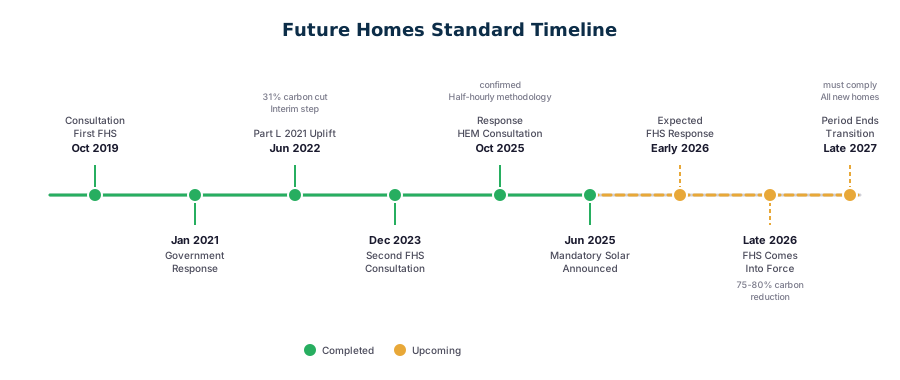
| Milestone | Date | Status |
|---|---|---|
| First FHS consultation | October 2019 | Complete |
| Government response to first consultation | January 2021 | Complete |
| Part L 2021 uplift (interim step) | June 2022 | In force |
| Second FHS consultation (2023) | December 2023 | Complete |
| HEM consultation response | October 2025 | Published |
| Mandatory solar announcement | June 2025 | Confirmed |
| Approved Documents published | 24 March 2026 | Published |
| FHS comes into force | 24 March 2027 | Confirmed |
| HRB provisions in force | 24 September 2027 | Confirmed |
| Transitional period ends | 24 March 2028 | Confirmed |
For live updates and detailed milestone tracking, see our Timeline & Status page.
Transitional Arrangements
The regulations include a 12-month transitional period running from 24 March 2027 to 24 March 2028. The arrangements are stricter than previous regulatory uplifts:
- Projects with applications submitted before 24 March 2027 can build to Part L 2021 if commenced before 24 March 2028
- Projects submitted on or after 24 March 2027 must comply with FHS immediately
- After the transitional period ends on 24 March 2028, all new homes must comply with FHS regardless of when they were registered
- Transitional arrangements operate on an individual building basis, not site-wide, so different homes on the same site may fall under different regulations
- “Commence” is defined to include drainage and foundation work, not just superstructure
These arrangements mean developers should expect a surge in plot registrations before the cut-off date. For detailed guidance on transitional strategies, see our Transitional Arrangements page.
Who Does the FHS Affect?
The Future Homes Standard affects everyone involved in building new homes in England. The impacts vary significantly by role:
SAP Assessors
Assessors face the most significant operational changes. HEM requires substantially more data than SAP. Testing shows a standard house type takes approximately 1 hour 40 minutes in HEM versus around 20 minutes in SAP (excluding geometry and U-value calculations). New data points include detailed geometry, individual hot water outlet specifications, specific product data for all heating and ventilation equipment, and inverter specifications for PV systems. Missing data triggers punitive default values that are far more severe than in SAP.
Architects
Design decisions carry greater weight under HEM's more accurate modelling. Form factor becomes critical (compact thermal envelopes with a form factor below 3 are strongly favoured), orientation matters more due to half-hourly solar modelling, and thermal bridge-free detailing is increasingly important since thermal bridges are calculated at every timestep.
Developers
The FHS Impact Assessment estimates an additional build cost of approximately £4,350 per dwelling (weighted average, 2025 prices), driven primarily by heat pump installation, solar PV, enhanced insulation, and mechanical ventilation. FHS homes will have significantly lower running costs than typical existing homes, making them more attractive to buyers. Developers must plan procurement carefully, since heat pump and solar PV demand will spike as the deadline approaches.
Builders
On-site construction practices change substantially. Heat pump installation becomes standard, mechanical ventilation systems (whether dMEV or MVHR) must be planned from the design stage, enhanced insulation means thicker wall builds and high-performance glazing, and airtightness requires meticulous construction detailing. The Building Safety Act also requires comprehensive digital records (the “Golden Thread”) for higher-risk buildings.
How FHS Relates to HEM
The Home Energy Model (HEM) is the calculation methodology that underpins FHS compliance. The relationship works as follows:
- HEM's core engine is a building physics simulation that models energy performance at half-hourly intervals
- The FHS wrapper sits on top of the core engine, adding the specific policy rules, notional building specifications, and compliance metrics required by the Future Homes Standard
- ECaaS (Energy Calculation as a Service) is the cloud API that delivers HEM to the industry, ensuring every assessment uses the identical calculation engine
- SAP 10.3 is available as an alternative compliance route during the transition, but HEM is the government's preferred long-term methodology
This modular approach means the FHS wrapper can be updated independently of the core physics engine, and future policy wrappers (such as the EPC wrapper currently under consultation) can be added without changing the underlying science. For more on how the calculation works, see SAP vs HEM.
FHS vs Part L 2021: What Changes?
The 2021 Part L uplift (which came into force in June 2022) was described as an interim step towards the Future Homes Standard. It required a 30% reduction in carbon emissions. The FHS takes this significantly further:
| Requirement | Part L 2021 | Future Homes Standard |
|---|---|---|
| Carbon reduction (vs 2013) | 30% | At least 75% |
| Heating system | Gas boilers still permitted | Low-carbon heating required (heat pumps, heat networks) |
| Solar PV | Not required (but helps compliance) | Mandatory (40% ground floor area coverage target) |
| Airtightness target | 8 m³/(h·m²) @ 50 Pa limit | 3 m³/(h·m²) @ 50 Pa notional |
| Wall U-value (notional) | 0.26 W/m²K | 0.15 W/m²K (HEM) / 0.18 (SAP 10.3) |
| Compliance methodology | SAP 10.2 | HEM or SAP 10.3 |
| Software delivery | Third-party SAP engines | Centralised ECaaS API |
| Zero carbon ready | No | Yes |
For a detailed breakdown of every Part L change, see our Part L Changes page.
Frequently Asked Questions
What is the Future Homes Standard?
The Future Homes Standard is the 2026 update to Part L of the Building Regulations for England, published in March 2026. It requires all new homes to produce at least 75% less carbon emissions than homes built to the 2013 standards, effectively mandating heat pumps, solar PV, and significantly improved building fabric. The FHS makes new homes “zero carbon ready”, designed to reach net zero as the electricity grid decarbonises.
When does the Future Homes Standard come into force?
The FHS comes into force on 24 March 2027. The Approved Documents were published on 24 March 2026. A 12-month transitional period runs until 24 March 2028. See our Timeline & Status page for all milestones.
Are gas boilers banned under the Future Homes Standard?
The FHS does not use the word “ban”, but its carbon targets are set at a level that gas boilers cannot meet. New homes will need low-carbon heating, primarily heat pumps. Hybrid and hydrogen-ready boilers will not comply. Importantly, existing homes are not affected: you can still install or replace a gas boiler in an existing property.
Does the Future Homes Standard require solar panels?
Yes. Requirement L3, enacted in the March 2026 Building Regulations amendments, makes on-site renewable electricity generation a functional requirement. Developers must achieve PV coverage equivalent to 40% of the dwelling's ground floor area where feasible (AD L1 para 5.73).
How much more will FHS homes cost to build?
The FHS Impact Assessment estimates an additional build cost of approximately £4,350 per dwelling (weighted average, 2025 prices), driven by heat pumps, solar PV, enhanced insulation, and mechanical ventilation. FHS homes will have significantly lower running costs than typical existing homes and will not pay a gas standing charge. However, bill savings compared to a Part L 2021 new build may be marginal, as heat pumps use electricity which costs approximately four times more per unit than gas. The cost premium is expected to narrow as supply chains mature.
What are the transitional arrangements?
The transitional period runs from 24 March 2027 to 24 March 2028. Projects with applications submitted before March 2027 can build to Part L 2021 if commenced within the window. Older transitional provisions (2013 and 2021) have been revoked. Arrangements operate on an individual building basis. For detailed guidance, see Transitional Arrangements.
Does the FHS apply to existing homes?
No. The Future Homes Standard applies only to new-build homes in England. Existing homes are not required to retrofit to FHS standards. However, HEM will eventually be used for existing home EPCs through a separate EPC wrapper, which was consulted on in January 2026.
What is the relationship between HEM and the FHS?
The Home Energy Model (HEM) is the calculation methodology used to demonstrate FHS compliance. HEM's core engine simulates building physics at half-hourly intervals, while its FHS wrapper applies the specific policy rules and notional building specifications. SAP 10.3 can also be used during the transition period.
Related Pages
Part L Changes Explained
New U-values, airtightness targets, and heating requirements under the FHS.
FHS Compliance Pathways
Choose between HEM and SAP 10.3 routes for demonstrating compliance.
What is HEM?
Understand the calculation methodology that underpins FHS compliance.
Timeline & Status
Live tracker of FHS, HEM, and EPC reform milestones.