The Home Energy Model (HEM) is the UK Government's next-generation calculation methodology for assessing the energy performance of domestic buildings. It replaces the Standard Assessment Procedure (SAP), which has been in use since 1993, with a far more accurate half-hourly dynamic simulation of a home's energy use, carbon emissions, and running costs.
Developed by a consortium led by BRE (Building Research Establishment) and commissioned by DESNZ (Department for Energy Security and Net Zero), HEM is built on international standard BS EN ISO 52016-1:2017 for dynamic thermal modelling. The source code is open source under the MIT Licence.
Why Does HEM Matter?
HEM represents the biggest change to UK home energy assessment in over 30 years. It matters because the way we measure home energy performance directly shapes how homes are designed, built, and rated, and SAP was no longer fit for purpose.
Designed in 1993 for pen-and-paper calculations, SAP's core structure remained largely unchanged despite periodic updates. Its monthly time resolution simply cannot accurately model the modern low-carbon technologies that the UK's net zero targets depend on: heat pumps with variable performance, solar panels generating electricity throughout the day, and batteries storing energy for evening use.
HEM fixes this by simulating a home's energy performance every 30 minutes across an entire year. This means it can capture how a heat pump's efficiency changes with outdoor temperature hour by hour, how solar PV generation matches household demand, and how smart controls and time-of-use tariffs affect real energy costs.
The Climate Change Committee recommended replacing SAP in both 2019 and 2022, recognising that the UK's decarbonisation objectives require a calculation methodology that can properly reward low-carbon design.
Who Does HEM Affect?
HEM will eventually affect everyone involved in UK housing, from the professionals who design and build homes to the people who live in them.
- SAP assessors face significantly increased data requirements and will need to learn a new methodology. Testing shows a standard house type takes approximately 1 hour 40 minutes in HEM versus around 20 minutes in SAP.
- Architects will find that design decisions like building form factor, orientation, and glazing strategy matter more than ever under HEM's half-hourly modelling.
- Property developers need to prepare for the Future Homes Standard, with cost increases estimated at 3–5% and critical transitional arrangement deadlines.
- Builders will see gas boilers effectively phased out for new builds, replaced by heat pumps, enhanced insulation, and solar PV as standard.
- Homeowners and landlords will eventually see more accurate EPCs that better reflect their home's actual energy performance and costs.
How Does HEM Work?
At its core, HEM is a building physics simulation. It takes detailed data about a home (its construction, heating system, ventilation, insulation, glazing, orientation, and local weather) and calculates its energy performance at half-hourly intervals throughout a full year.
Modular Architecture
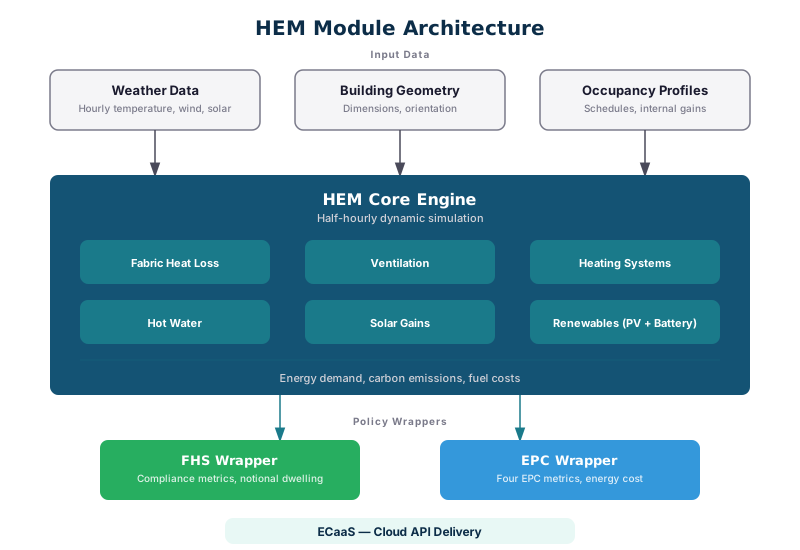
One of HEM's key innovations is its modular design. The system separates the core calculation engine (building physics) from policy-specific wrappers:
- The core engine handles the physics simulation: fabric heat loss, ventilation, solar gains, thermal mass, heating systems, hot water, and electricity generation.
- The FHS wrapper adds the policy rules for Future Homes Standard compliance (notional building specifications, compliance metrics, standardised assumptions).
- The EPC wrapper (under development) will add the rules for producing Energy Performance Certificates, including a reduced data methodology for existing homes.
This means the core physics engine can be updated independently of policy assumptions, and different wrappers can evolve at their own pace.
The Calculation
For each half-hourly timestep, HEM runs through a calculation loop:
- Calculate hot water demand and the energy needed to supply it
- Calculate space heating or cooling demand and the energy to supply it
- Handle multi-service systems (such as combi boilers that provide both heating and hot water)
- Calculate electricity generation from solar PV, self-consumption, and battery storage
- Return results to the policy wrapper for post-processing and compliance checking
This process repeats 17,520 times to cover every half-hour of the year, using hourly weather data for the specific location.
ECaaS: Centralised Delivery
Unlike SAP, where multiple software providers each built their own calculation engine (leading to inconsistencies between providers), HEM is delivered through ECaaS (Energy Calculation as a Service), a cloud-based API run by MHCLG.
ECaaS will be the only valid means to confirm compliance with Part L when using the Future Homes Standard. Software providers build user interfaces on top of the API, but every assessment uses the identical calculation engine. This eliminates the inconsistencies that plagued SAP, where different software could produce different results for the same dwelling.
Key Differences from SAP
The differences between SAP and HEM are fundamental. This isn't simply an update to SAP; it's a completely new methodology built from the ground up. For a detailed breakdown, see our full SAP vs HEM comparison.
| Feature | SAP 10.2 | HEM |
|---|---|---|
| Time resolution | Monthly (12 periods/year) | Half-hourly (17,520 periods/year) |
| Thermal zones | 2 fixed zones | User-defined zones |
| Heat pump modelling | Simplified fixed COP values | Dynamic COP curves varying with temperature |
| Overheating assessment | Simplified check | Full dynamic assessment |
| Solar PV | Annual yield estimate | Half-hourly generation and self-consumption |
| Battery storage | Not modelled | Charge/discharge cycles modelled |
| Hot water | Monthly demand based on floor area | Individual tapping events, stratified cylinders |
| Carbon emission factors | Historical (2012 vintage) | Forward-looking (2025–2029 average) |
| Software delivery | Multiple third-party engines | Centralised cloud API (ECaaS) |
| Source code | Closed (SAP specification document) | Open source (MIT Licence) |
When Does HEM Take Effect?
HEM is being introduced alongside the Future Homes Standard (FHS), which is the update to Part L of the Building Regulations for England. The timeline has shifted several times, but as of early 2026:
- October 2025: The government published its response to the HEM consultation, confirming the half-hourly methodology and ECaaS delivery model.
- January 2026: The HEM: EPC Assessment consultation was published, proposing how HEM will be used for existing dwellings and new EPC metrics. This consultation closes on 18 March 2026.
- 24 March 2026: The government publishes the final FHS Approved Documents, including new Part L and Part F requirements.
- 24 March 2027: The Future Homes Standard comes into force. SAP 10.3 is the sole compliance methodology at launch.
- H2 2027: New HEM-based EPCs are now expected in the second half of 2027, delayed from the original October 2026 target. They will run alongside the existing Energy Efficiency Rating for a transition period.
What Does HEM Mean for EPCs?
HEM will transform Energy Performance Certificates. The January 2026 consultation proposes four new EPC headline metrics to replace the current single A–G rating:
- Fabric Performance, measuring the energy efficiency of the building envelope (walls, roof, windows, floors) using a Fabric Energy Efficiency methodology.
- Heating System, rating the efficiency and emissions of the heating system. Notably, fossil fuel systems cannot achieve band C under the proposed EPC framework.
- Smart Readiness, assessing on-site generation (solar PV), storage (batteries), and demand flexibility capabilities.
- Energy Cost, shown as annual estimates in pounds rather than the abstract letter bands used today.
These changes aim to give homeowners, buyers, and tenants far more useful information about a property's actual energy performance. For more detail, see our EPCs & HEM section.
HEM Is Open Source
In a significant departure from SAP, HEM's source code is published under the MIT Licence (Crown Copyright). Two implementations exist:
- Python reference implementation, developed by BRE, hosted on GitHub. This is the reference methodology used for ongoing development.
- Rust performance implementation, developed by MHCLG, hosted on GitHub. This powers the ECaaS platform.
The government's October 2025 consultation response revealed strong industry appetite for collaboration: 68 of 80 respondents expressed eagerness to contribute to the codebase, suggesting workshops, industry forums, working groups, and even hackathons as ways to engage.
Frequently Asked Questions
What is the Home Energy Model?
The Home Energy Model (HEM) is the UK Government's next-generation calculation methodology for assessing the energy performance of domestic buildings. It replaces SAP with a half-hourly dynamic simulation that models energy use, carbon emissions, and running costs far more accurately.
When does the Home Energy Model come into effect?
The FHS comes into force on 24 March 2027, with SAP 10.3 as the sole methodology. HEM follows a minimum of three months later, then both run in parallel for at least 24 months. See our Timeline page for all milestones.
What is replacing SAP?
SAP is being replaced by the Home Energy Model (HEM). HEM uses 17,520 half-hourly calculation periods per year compared to SAP's 12 monthly periods, enabling far more accurate modelling of modern low-carbon technologies. For the full comparison, see SAP vs HEM.
How does HEM differ from SAP?
The differences are fundamental: half-hourly vs monthly time resolution; dynamic vs simplified heat pump modelling; full battery storage simulation; forward-looking vs historical carbon factors; and centralised delivery through ECaaS rather than multiple competing software engines. See the comparison table above.
Will HEM affect existing homes?
Yes, eventually. HEM will first apply to new builds through the Future Homes Standard. A separate consultation published in January 2026 proposes how HEM will produce EPCs for existing dwellings. New HEM-based EPCs are now expected in the second half of 2027, delayed from the original October 2026 target.
Is HEM open source?
Yes. The source code is published under the MIT Licence (Crown Copyright), with implementations in both Python (BRE, on GitHub) and Rust (MHCLG, on GitHub). The government actively encourages industry collaboration on the codebase.
What is ECaaS?
ECaaS (Energy Calculation as a Service) is the cloud-based API that delivers HEM. Run by MHCLG, it will be the only valid means to confirm Part L compliance under the Future Homes Standard. Software providers build user interfaces on top of the API, ensuring consistent results across all assessments.
Related Pages
SAP vs HEM: What’s Changed?
Detailed side-by-side comparison of the two methodologies.
Why is SAP Being Replaced?
The history and limitations that led to HEM’s development.
The History of SAP and RdSAP
How SAP evolved from 1993 through nine versions, and why patching was never enough.
Future Homes Standard
How HEM underpins the biggest change to Part L since 2006.
EPCs & HEM
How Energy Performance Certificates are changing under the Home Energy Model.