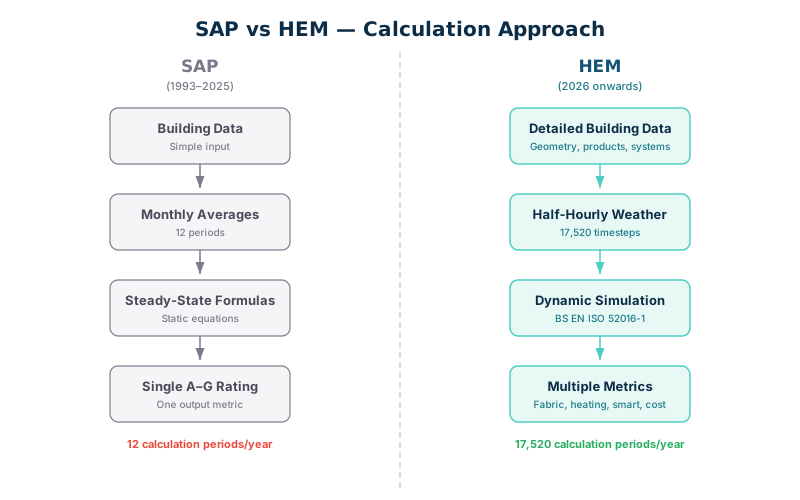
The Home Energy Model (HEM) is not an update to SAP ; it is a completely new methodology built from the ground up. Where SAP uses 12 monthly averages to estimate a home's energy performance, HEM runs a dynamic simulation every 30 minutes across an entire year, producing 17,520 calculation periods instead of 12. This fundamental shift enables accurate modelling of heat pumps, solar PV, battery storage, and smart technologies that SAP was never designed to handle.
RdSAP vs SAP: What Is the Difference?
Before comparing SAP with HEM, it is worth clarifying the distinction between SAP and RdSAP. SAP (Standard Assessment Procedure) is used for new-build homes, where full design data is available. RdSAP (Reduced Data SAP) is a simplified version used for existing homes during an EPC assessment, where the assessor must estimate values that cannot be measured directly. Both are being replaced: SAP by HEM for new builds, and RdSAP by a new HEM-based methodology for existing homes. See our RdSAP transition guide for details on how existing home assessments are changing.
Complete Comparison Table
The table below summarises every major difference between SAP 10.2 and HEM. Each difference is explained in detail in the sections that follow.
| Feature | SAP 10.2 | HEM |
|---|---|---|
| Time resolution | Monthly (12 periods/year) | Half-hourly (17,520 periods/year) |
| Physics basis | Simplified monthly steady-state method | Dynamic simulation (BS EN ISO 52016-1:2017) |
| Thermal zones | 2 fixed (living area + rest of dwelling) | User-defined zones |
| Heat pump modelling | Simplified seasonal COP (fixed values) | Dynamic COP varying with source/sink temperature |
| Ventilation | Simplified wind and shelter factors | Pressure-driven model (BS EN 16798-7:2017) |
| Solar gains | Monthly radiation, windows only | Hourly direct + diffuse, windows and fabric absorption |
| Thermal mass | Simplified thermal mass parameter | Full dynamic thermal modelling at each timestep |
| Overheating | Simplified check | Full dynamic overheating assessment |
| Hot water demand | Monthly total based on floor area | Individual tapping events with stratified cylinder modelling |
| Solar PV | Annual yield estimate | Half-hourly generation with self-consumption modelling |
| Battery storage | Not modelled | Charge/discharge behaviour modelled |
| Carbon emission factors | Historical (2012 vintage in RdSAP 10) | Forward-looking (2025–2029 average) |
| Weather data | Regional monthly averages | Hourly data in CIBSE or EPW format |
| Software delivery | Multiple third-party calculation engines | Centralised cloud API (ECaaS) |
| Source code | Closed (SAP specification document) | Open source under MIT Licence |
| Calculation time | Near-instantaneous | Under 2 seconds (via ECaaS) |
Time Resolution: Monthly vs Half-Hourly
This is the single most important difference between SAP and HEM, and it underpins every other improvement.
SAP calculates energy performance using monthly averages. It takes the average outdoor temperature for January, the average solar radiation for January, the average heating demand for January, and produces a single set of results for that month. It then repeats for each of the remaining 11 months. This approach was practical in 1993 when calculations were done by hand, but it fundamentally cannot capture how modern technologies behave in real time.
HEM calculates at half-hourly intervals, 17,520 timesteps across the year. At each timestep, it knows the exact outdoor temperature, solar position, wind speed, and internal conditions. This means it can model:
- How a heat pump's efficiency drops as the temperature falls from 8°C to −3°C during a cold January night
- How solar panels generate electricity during the day while the household's demand peaks in the evening
- How a battery stores surplus midday solar generation for use after sunset
- How thermal mass in concrete floors absorbs daytime solar gains and releases heat slowly overnight
- How smart controls and time-of-use tariffs can shift demand to cheaper, lower-carbon electricity periods
None of these behaviours can be captured by monthly averages. SAP effectively averages away the very dynamics that make modern low-carbon technologies work.
Heat Pump Modelling
Heat pumps are central to the UK's decarbonisation strategy, and their accurate modelling is one of HEM's most significant improvements over SAP.
How SAP Models Heat Pumps
SAP uses a simplified seasonal performance factor , essentially a fixed efficiency value (COP) applied across the entire heating season. This doesn't account for the fact that a heat pump's efficiency varies dramatically depending on the temperature difference between the heat source (outdoor air or ground) and the heat sink (the flow temperature to radiators or underfloor heating).
How HEM Models Heat Pumps
HEM models heat pump performance dynamically at each half-hourly timestep using the methodology in HEM-TP-12, which draws on EN 14825 and EN 15316-4-2. At each timestep, HEM calculates:
- The source temperature (outdoor air temperature for ASHPs, or ground temperature for GSHPs)
- The sink temperature (flow temperature required by the emitters based on the heating demand at that moment)
- The COP at those specific conditions, using the heat pump's performance data curves
Solar PV and Battery Storage
The modelling of on-site electricity generation and storage is another area where the gap between SAP and HEM is vast.
SAP's Approach
SAP estimates an annual yield for a PV array based on its size, orientation, and tilt, then distributes that yield across the year. It has no concept of when during the day electricity is generated, and it cannot model battery storage at all.
HEM's Approach
HEM (via HEM-TP-18) calculates PV generation at each half-hourly timestep using the actual solar irradiance from the weather data, the panel orientation, and inverter specifications. It then compares this generation with the household's electrical demand at that same timestep to determine self-consumption (how much of the generated electricity is used directly rather than exported to the grid).
For homes with battery storage, HEM models the charge and discharge cycles: surplus generation charges the battery during the day, and stored energy is discharged during evening demand peaks. This reflects real-world behaviour that SAP simply cannot represent.
Ventilation Modelling
SAP uses simplified wind and shelter factors to estimate infiltration and ventilation rates. The calculation considers the basic characteristics of the building envelope but cannot model the complex pressure-driven airflow through a building in any detail.
HEM uses a detailed pressure-driven ventilation model based on BS EN 16798-7:2017 (as described in HEM-TP-06). This models air movement through specific paths (purpose-provided ventilation openings, extract fans, MVHR systems, and infiltration through the building fabric) driven by the wind pressure and stack effect at each timestep.
This is particularly important for airtight homes with MVHR (Mechanical Ventilation with Heat Recovery), where the interaction between controlled ventilation and residual infiltration significantly affects energy performance. HEM can properly credit the heat recovery achieved by a well-installed MVHR system in a way that SAP's simplified approach cannot fully capture.
Hot Water Calculation
SAP estimates monthly hot water demand based primarily on floor area, applying a simple formula that assumes a standard pattern of hot water use. The hot water cylinder is modelled as a single well-mixed volume.
HEM (via HEM-TP-09 and HEM-TP-11) takes a fundamentally different approach:
- Individual tapping events are modelled: baths, showers, basin taps, and kitchen sinks, each with specified flow rates and temperatures.
- Stratified cylinder modelling divides the hot water storage tank into layers, reflecting the real behaviour where hot water sits at the top and cold water at the bottom.
- Pipework losses are calculated based on actual pipe lengths, diameters, and insulation rather than simplified defaults.
This level of detail means HEM can distinguish between a well-designed hot water system with short pipe runs and proper insulation, and a poorly designed one with long, uninsulated pipes, a distinction that SAP's simplified model largely overlooks.
Carbon Emission Factors
One of the most consequential, and often overlooked, differences between SAP and HEM is how they treat carbon emission factors for electricity.
SAP (specifically RdSAP 10) uses historical carbon factors based on the 2012 electricity grid mix. This significantly overestimates the carbon intensity of electricity today, because the UK grid has decarbonised dramatically since 2012 through the growth of wind, solar, and nuclear generation.
HEM uses forward-looking carbon factors based on the projected 2025–2029 average grid mix. This better reflects the reality that electricity-powered heating (heat pumps) is far cleaner than SAP suggests, while also accounting for the continuing decarbonisation of the grid.
Software Delivery: Multiple Providers vs ECaaS
The way SAP and HEM are delivered to assessors represents a fundamental change in approach.
SAP's Delivery Model
Under SAP, multiple third-party software providers each build their own implementation of the SAP calculation engine. Assessors choose from competing software packages (Elmhurst, Stroma, NHER, etc.), each interpreting the SAP specification document independently.
The October 2025 government consultation response confirmed what the industry had long recognised: this model leads to inconsistencies between providers, slow updates when the methodology changes, and a lack of accountability. Of 84 respondents, 49 agreed that the SAP delivery model had these problems.
HEM's ECaaS Model
HEM is delivered through ECaaS (Energy Calculation as a Service) , a centralised cloud-based API run by MHCLG. Software providers still build user interfaces, but they all call the same calculation engine. This means:
- Every assessment uses identical calculations, eliminating inconsistencies between providers
- Updates to the methodology are deployed centrally and take effect immediately for all users
- The calculation engine is open source (MIT Licence), enabling industry scrutiny and collaboration
- Software competition shifts to user experience and workflow tools rather than calculation accuracy
What This Means in Practice
The technical differences above translate into real-world consequences for everyone involved in UK housing.
For SAP Assessors
The shift to HEM means significantly more data is required for each assessment. Testing during the consultation period showed that a standard house type takes approximately 1 hour 40 minutes to input in HEM, compared to around 20 minutes in SAP (excluding geometry and U-value calculations).
New data points include individual hot water outlet specifications (tap flow rates, shower types), detailed pipework lengths and insulation, specific make and model data for all heating and ventilation equipment, and inverter specifications for PV systems. Where data is missing, HEM applies punitive default values that are likely far more severe than SAP's defaults, making comprehensive data collection essential.
For detailed guidance, see our SAP Assessor Transition Guide.
For Architects
HEM's half-hourly modelling makes design decisions matter more. Building form factor (the ratio of thermal envelope area to floor area) becomes critical , and compact designs perform better. Orientation is rewarded more accurately. Draft glazing tables cap glazing at 25% of total floor area, with roughly 55% south-facing and 15% north-facing recommended. Thermal bridges are assessed at each timestep rather than as a simple annual uplift.
Read more in our Architect's Guide to HEM.
For Developers
The FHS Impact Assessment estimates compliance costs of approximately £4,350 per dwelling (weighted average, 2025 prices). Compared to a typical existing home, running costs will be significantly lower, though compared to a Part L 2021 new build the difference may be marginal because heat pumps use electricity, which costs approximately four times more per unit than gas. Early procurement of heat pumps and solar PV is critical as demand is expected to spike ahead of the March 2027 transitional deadline.
See our Developer Compliance Guide for transitional arrangement strategy.
For Builders
On site, the most visible changes are the shift from gas boilers to heat pumps, the addition of solar PV to most new homes, mechanical ventilation (dMEV or MVHR) in airtight buildings, and enhanced insulation with tighter construction detailing. Airtightness testing remains required, but targets are tighter. The Building Safety Act also requires comprehensive digital records (the Golden Thread).
Our Builder's Guide covers the practical construction changes.
For Homeowners
For people buying, selling, or renting homes, the key change is that EPCs will become more accurate and more useful. The January 2026 HEM: EPC consultation proposes four new headline metrics (fabric performance, heating system, smart readiness, and energy cost in pounds) to replace the single A–G rating. This means EPCs will better reflect what it actually costs to heat and run a home.
For more, see HEM and Your Home.
Frequently Asked Questions
What is the main difference between SAP and HEM?
The most fundamental difference is time resolution. SAP calculates energy performance using 12 monthly averages, while HEM uses 17,520 half-hourly timesteps across the year. This enables HEM to accurately model dynamic technologies like heat pumps, solar PV, battery storage, and smart controls that SAP cannot properly assess. For the full comparison, see the comparison table above.
Is HEM more accurate than SAP?
Yes, significantly. HEM uses dynamic thermal simulation based on BS EN ISO 52016-1:2017, rather than SAP's simplified monthly steady-state method. It models heat pump COP variation with outdoor temperature, solar PV self-consumption patterns, battery storage charge/discharge cycles, and thermal mass effects, none of which SAP can properly capture.
Will SAP still be used alongside HEM?
Yes, temporarily. The government confirmed in May 2025 that both SAP 10.3 and HEM can be used for Future Homes Standard compliance during a phased transition. SAP 10.3 is the sole methodology at FHS launch, with HEM approved a minimum of three months later. The dual running period lasts at least 24 months, with six months' notice before SAP 10.3 is withdrawn.
How does HEM model heat pumps differently from SAP?
SAP uses fixed seasonal COP values. HEM models heat pump performance dynamically at each half-hourly timestep, varying the COP based on the actual source temperature (outdoor air or ground) and sink temperature (flow temperature to emitters). This properly rewards well-designed systems with appropriately sized low-temperature emitters. See the heat pump section above for details.
What happens to SAP assessors when HEM replaces SAP?
Assessors will need to learn the new methodology, which requires considerably more data. Assessment time increases significantly. All assessments will use the centralised ECaaS platform rather than individual software packages. Our Assessor Transition Guide covers this in detail.
Does HEM replace RdSAP for existing homes?
Eventually, yes. HEM will first apply to new builds through the Future Homes Standard. The HEM: EPC Assessment consultation (January 2026) proposes how HEM will be used for existing dwellings, including a reduced data methodology. New HEM-based EPCs are now expected in the second half of 2027, delayed from the original October 2026 target.
Related Pages
What is the Home Energy Model?
Comprehensive introduction to HEM for all audiences.
Why is SAP Being Replaced?
The history and limitations that led to HEM’s development.
Timeline & Status
Live tracker of HEM, FHS, and EPC reform milestones.
EPCs & HEM
How Energy Performance Certificates are changing under HEM.