Fabric heat loss is the transfer of heat energy through a building's physical envelope: its walls, floors, roof, windows, and doors. It is typically the largest component of a home's total heat loss and the primary target of the insulation and airtightness requirements in Part L of the Building Regulations. The Home Energy Model (HEM) calculates fabric heat loss by applying the thermal transmittance (U-value) and area of every building element to the instantaneous temperature difference between inside and outside at each of its 17,520 half-hourly timesteps. This dynamic approach, documented in HEM-TP-05, replaces SAP's simplified monthly method with a physics-based calculation grounded in BS EN ISO 6946:2017 for thermal resistance and transmittance, capturing peak heat loss during cold spells rather than averaging it away across an entire month.
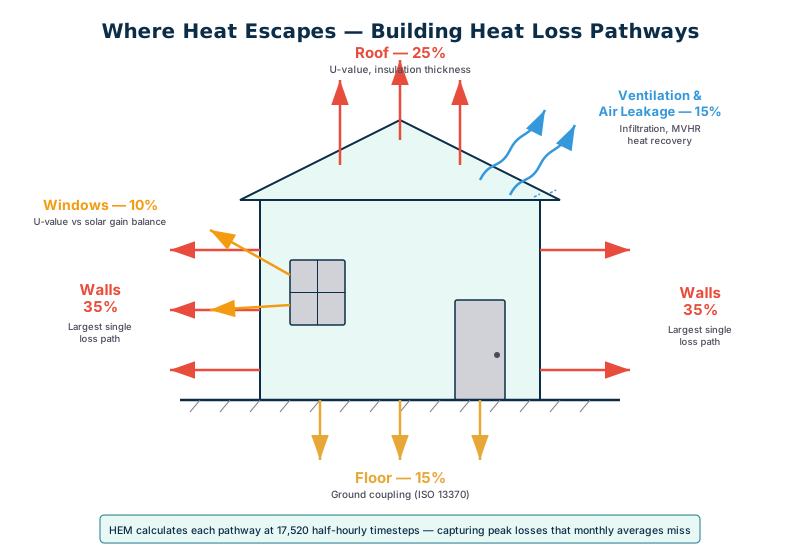
The Fundamental Fabric Heat Loss Equation
At each half-hourly timestep t, HEM calculates the total fabric heat loss rate Qfabric(t) as the sum of transmission losses through every building element plus losses through thermal bridges:
Qfabric(t) = Σ(Ui × Ai × ΔT(t)) + Σ(ψj × lj × ΔT(t)) + Σ(χk × ΔT(t))
Where:
- Ui is the thermal transmittance (W/m²K) of building element i (wall, floor, roof, window, or door)
- Ai is the area (m²) of element i
- ΔT(t) is the temperature difference (K) between the internal zone temperature and the external air temperature at timestep t
- ψj is the linear thermal transmittance (W/mK) of thermal bridge junction j
- lj is the length (m) of junction j
- χk is the point thermal transmittance (W/K) of point thermal bridge k
The critical distinction from SAP is that ΔT(t) varies at every timestep. SAP uses monthly average temperatures, so a January with mixed conditions (some nights at −5°C, some days at 10°C) is treated as a single average. HEM captures every cold snap and every mild spell individually, which means the model accurately reflects periods of peak heating demand when fabric performance is most critical. This is essential for correctly sizing heating systems, particularly heat pumps, which must meet demand at design conditions rather than average conditions.
U-Value Calculation Methodology
HEM derives U-values following the established standards for each element type. The U-value represents the rate of heat transfer through a building element per unit area per degree of temperature difference, expressed in W/m²K. Lower values indicate better insulation performance.
Opaque Elements: Walls, Floors, and Roofs
For opaque elements such as external walls and roofs, HEM follows BS EN ISO 6946:2017 to calculate U-values from a layer-by-layer build-up. The total thermal resistance Rtotal is the sum of the resistances of each layer plus the internal and external surface resistances:
Rtotal = Rsi + R1 + R2 + … + Rn + Rse
Each layer's thermal resistance is calculated as R = d / λ, where d is the thickness (m) and λ is the thermal conductivity (W/mK). The U-value is then the reciprocal of the total resistance: U = 1 / Rtotal.
Standard surface resistances for a horizontal heat flow are Rsi = 0.13 m²K/W (internal) and Rse = 0.04 m²K/W (external). For upward heat flow (roofs), Rsi = 0.10 m²K/W; for downward heat flow (ground floors), Rsi = 0.17 m²K/W.
BS EN ISO 6946 also requires corrections for:
- Mechanical fasteners that penetrate insulation layers (e.g., wall ties through cavity insulation), calculated as a ΔUf correction
- Air gaps within the construction (unventilated, slightly ventilated, or well-ventilated cavities each have different treatment)
- Inhomogeneous layers where materials of different conductivity sit side by side (e.g., timber studs within mineral wool insulation in a timber-frame wall), addressed using the upper and lower bound method
Ground Floors
Ground floor U-values follow BS EN ISO 13370:2017, which accounts for the thermal coupling between the building and the ground. The calculation depends on the floor geometry, soil thermal conductivity, and the presence of edge insulation. The key parameter is the characteristic dimension B' = A / (0.5 × P), where A is the floor area and P is the exposed perimeter.
Large, compact ground floors with a high B' value achieve lower U-values because the ground itself provides thermal resistance across the central area. Edge insulation, placed either horizontally beneath the slab perimeter or vertically at the foundation wall, reduces heat loss at the perimeter where it is greatest. The FHS notional specification of 0.13 W/m²K typically requires continuous insulation of at least 100–150 mm of PIR or equivalent, depending on the floor geometry.
Windows and Doors
Window and door U-values follow BS EN ISO 10077-1:2017, which considers the thermal transmittance of the glazing unit (Ug), the frame (Uf), and the linear thermal bridge at the spacer bar (ψg):
Uw = (Ag × Ug + Af × Uf + lg × ψg) / Aw
Where Ag is the glazing area, Af is the frame area, lg is the total perimeter of the glazing, and Aw is the total window area.
The FHS notional dwelling specifies windows at 1.2 W/m²K with a solar transmittance (g-value) of 0.63. Achieving this typically requires double glazing with a low-emissivity coating, argon- or krypton-filled cavity, and warm-edge spacer bars. Triple glazing is not mandated by the notional specification but may be needed in practice for dwellings with high form factors or north-facing facades where solar gains are minimal.
HEM also models the solar gain through windows at each timestep; see Solar Gains for the full methodology. The interplay between window U-value (which drives heat loss) and g-value (which drives solar gain) means that window specification involves a careful balance, particularly on south-facing elevations where a higher g-value can offset transmission losses during sunny winter days.
Thermal Bridging: Linear and Point Bridges
Thermal bridges are areas where the insulation layer is interrupted or reduced, creating localised paths of higher heat flow. In a well-insulated building, thermal bridges can account for 20–30% of total fabric heat loss, a proportion that increases as the U-values of planar elements improve. HEM treats thermal bridging with considerably more rigour than SAP.
Linear Thermal Bridges (ψ-values)
Linear thermal bridges occur at junctions between building elements (for example, where a wall meets a floor, a wall meets a roof, a window sits within a wall opening, or two walls meet at a corner). Each junction has a linear thermal transmittance (ψ-value, measured in W/mK) that represents the additional heat loss per metre of junction length beyond what would be calculated from the U-values of the adjoining elements alone.
HEM requires ψ-values for every junction in the thermal envelope. These can be sourced from:
- Bespoke thermal modelling to BS EN ISO 10211:2017 using finite element analysis software (the most accurate option)
- Approved construction details from the published Accredited Construction Details (ACDs) schemes, which provide pre-calculated ψ-values for common junction types
- Default values from Table R1 of Approved Document L ; these are conservative (punitive) values intended to discourage poor detailing
At each half-hourly timestep, the heat loss through a linear thermal bridge is calculated as Qψ(t) = ψ × l × ΔT(t), where l is the junction length and ΔT(t) is the instantaneous temperature difference. This means that thermal bridge losses respond to the same temperature dynamics as planar element losses; they peak during cold weather and diminish during mild periods.
Point Thermal Bridges (χ-values)
Point thermal bridges arise from discrete penetrations through the insulation layer, such as:
- Steel brackets or fixings supporting external cladding systems
- Structural columns or beams that pass through insulation
- Service penetrations (pipes, cables, flues) through the envelope
- Balcony connections in multi-storey residential buildings (often the most significant point bridges)
Each point bridge has a point thermal transmittance (χ-value, measured in W/K) and is evaluated at every timestep: Qχ(t) = χ × ΔT(t). While individually small, point bridges can collectively add significant heat loss, particularly in buildings with large numbers of cladding fixings or structural thermal bypasses.
SAP vs HEM: Fabric Heat Loss Approach
The following table summarises the key methodological differences between SAP and HEM in their treatment of fabric heat loss:
| Aspect | SAP 10.2 | HEM (TP-05) |
|---|---|---|
| Temperature difference | Monthly average ΔT (12 values/year) | Half-hourly instantaneous ΔT (17,520 values/year) |
| U-value standard | BS EN ISO 6946 (same basis) | BS EN ISO 6946:2017 with explicit fastener corrections |
| Ground floor method | BS EN ISO 13370 (simplified parameters) | BS EN ISO 13370:2017 with full characteristic dimension calculation |
| Window U-value | BS EN ISO 10077-1 (whole-window value) | BS EN ISO 10077-1:2017 with component-level frame and spacer modelling |
| Thermal bridging model | Single y-value uplift applied annually | Individual ψ and χ values evaluated at every timestep |
| Thermal bridge sources | ACDs or default y-value (0.15 W/m²K) | ψ/χ values from ISO 10211, ACDs, or punitive defaults per junction |
| Peak loss capture | Averaged across month; peaks masked | Fully captured at half-hourly resolution |
| Form factor sensitivity | Moderate influence | Strong influence; high form factors heavily penalised at peak |
| Zone model | Two fixed zones (living area + rest) | User-defined zones with individual temperature profiles |
Future Homes Standard: Notional Dwelling Fabric
The Future Homes Standard (FHS) defines a notional dwelling with specific fabric performance targets. To demonstrate compliance, the actual dwelling must achieve a carbon emission rate and primary energy rate no worse than the notional dwelling when assessed through HEM (or SAP 10.3 during the dual-running transition period).
The notional dwelling fabric specifications represent a substantial step up from current Part L 2021 requirements:
| Element | Part L 2021 Limiting | FHS Notional | Improvement |
|---|---|---|---|
| External walls | 0.26 W/m²K | 0.15 W/m²K | 42% lower |
| Ground floor | 0.18 W/m²K | 0.11 W/m²K | 39% lower |
| Roof | 0.16 W/m²K | 0.11 W/m²K | 31% lower |
| Windows | 1.6 W/m²K | 1.2 W/m²K | 25% lower |
| Doors | 1.6 W/m²K | 1.0 W/m²K | 38% lower |
| Airtightness | 8 m³/(h·m²) @ 50 Pa (backstop) | 3 m³/(h·m²) @ 50 Pa | 63% tighter |
Airtightness and Infiltration
The FHS notional dwelling specifies an airtightness of 3 m³/(h·m²) at 50 Pa, measured by pressurisation testing to BS EN ISO 9972:2015. This is a significant tightening from the Part L 2021 backstop of 8 m³/(h·m²) and considerably lower than the typical new-build achievement of around 4–5 m³/(h·m²) under current regulations.
Within HEM, the measured air permeability feeds into the pressure-driven ventilation model (HEM-TP-06, based on BS EN 16798-7:2017), which distributes infiltration across the building envelope based on wind pressure and stack effect at each timestep. This means airtightness performance affects not just total ventilation heat loss but also the pattern of losses across the day and year.
At 3 m³/(h·m²), most FHS dwellings will require mechanical ventilation with heat recovery (MVHR) to maintain adequate indoor air quality. Natural ventilation strategies become increasingly difficult to justify at these airtightness levels because the controlled air change rate from purpose-provided openings must compensate for very low background infiltration. HEM models the interaction between the MVHR system and residual infiltration dynamically, crediting the heat recovery efficiency at each timestep based on the balance between supply and extract airflows.
Form Factor and Compactness
The form factor is the ratio of the total thermal envelope area to the total internal floor area:
Form Factor = Aenvelope / Afloor
A detached bungalow might have a form factor of 4.0 or above (large roof and floor area relative to internal space), while a mid-terrace two-storey house might achieve 1.5 or less (shared party walls reduce exposed envelope). The FHS notional dwelling is calibrated at approximately 3.0, and HEM's dynamic calculation amplifies the impact of form factor compared to SAP's monthly approach.
This amplification occurs because a high form factor means more thermal envelope exposed to peak external conditions. During a cold winter night at −5°C, a dwelling with a form factor of 4.0 has proportionally far more surface losing heat than one at 2.0. SAP's monthly averaging smooths this effect; HEM captures it at every timestep. The practical consequence is that compact building forms (terraced houses, flats, multi-storey designs) are favoured under HEM, while detached bungalows and highly articulated designs face a steeper compliance path.
Designers working on dwelling types with form factors above 3.0 should consider compensating strategies:
- Enhanced fabric specifications: pushing U-values below the notional dwelling levels (e.g., walls at 0.15 W/m²K rather than 0.18)
- Improved thermal bridging: achieving lower ψ-values through bespoke junction modelling rather than relying on standard ACDs
- Tighter airtightness: achieving 1–2 m³/(h·m²) rather than the notional 3.0
- Higher-efficiency systems: specifying a heat pump with a higher seasonal COP to offset the greater fabric losses
Dynamic vs Steady-State Heat Loss
The distinction between dynamic and steady-state heat loss calculation is fundamental to understanding why HEM produces different results from SAP for the same building.
SAP's Steady-State Approach
SAP uses a quasi-steady-state monthly method. For each month, it assumes a constant internal temperature, a constant external temperature (the monthly average), and a fixed rate of heat loss based on these average conditions. Gains from solar radiation, metabolic heat, and appliances are calculated as monthly totals and then a “gain utilisation factor” is applied to determine how much of those gains usefully reduce the heating demand.
This approach works reasonably well for buildings with low thermal mass and conventional heating systems, where conditions change slowly relative to the monthly averaging period. However, it fundamentally cannot capture:
- Diurnal temperature swings: the difference between daytime highs and overnight lows within a single day
- Intermittent heating patterns: the effect of setback periods, night-time temperature reductions, and occupancy schedules
- Solar gain timing: whether solar energy arrives when the building needs heating (useful) or when it is already warm (potentially causing overheating)
- Thermal mass interactions: how heavyweight construction absorbs heat during warm periods and releases it during cold periods, smoothing the internal temperature profile
HEM's Dynamic Approach
HEM solves the heat balance equation at each half-hourly timestep following BS EN ISO 52016-1:2017. At each timestep, the model calculates:
- The fabric heat loss through every element using the instantaneous temperature difference
- The ventilation heat loss based on current wind speed, direction, and stack effect
- The solar gains based on the sun's current position and the prevailing sky conditions (direct and diffuse irradiance)
- The internal gains based on the occupancy schedule and appliance profiles for that time of day
- The thermal mass interaction: whether the building fabric is absorbing heat (warming up) or releasing it (cooling down) at that moment
- The resulting heating or cooling demand needed to maintain the zone setpoint, or the free-floating temperature if no system is active
This dynamic approach means that HEM can distinguish between two buildings with identical U-values but different thermal mass; a lightweight timber-frame house and a heavyweight masonry house will show different energy profiles even with the same insulation, because the masonry stores and releases heat over different timescales. For more on this interaction, see Thermal Mass.
Practical Implications for Design
The shift from SAP's monthly steady-state fabric assessment to HEM's dynamic half-hourly approach has several practical consequences for building design and specification:
Insulation Strategy
With the FHS notional dwelling specifying walls at 0.15 W/m²K, floors at 0.11 W/m²K, and roofs at 0.11 W/m²K, insulation thickness increases significantly. Typical build-ups to achieve these values include:
- Masonry cavity walls: 125–150 mm full-fill mineral wool or 100–120 mm PIR board within a 150 mm cavity, depending on the brick and block conductivities
- Timber-frame walls: 140 mm mineral wool between studs plus 50–80 mm continuous external insulation to mitigate the timber stud thermal bridging (the “repeating thermal bridge” within the frame)
- Ground floors: 100–150 mm PIR below or above slab, depending on floor type and characteristic dimension
- Pitched roofs: 300–400 mm mineral wool at ceiling level, or 150–200 mm rigid board between and below rafters for a warm roof
Junction Detailing
Because HEM evaluates thermal bridges at every timestep, the financial and compliance value of good junction detailing is greater than under SAP. Investing in bespoke thermal bridge calculations to BS EN ISO 10211:2017 rather than relying on default ψ-values can significantly improve the modelled performance, particularly for complex geometries with many junctions.
Key junctions to focus on include:
- Wall–floor junctions (ground floor perimeter and intermediate floors), often the highest total ψ-value contribution due to their length
- Window–wall junctions (head, sill, and jamb) , numerous and sensitive to frame position within the wall depth
- Wall–roof junctions (eaves and verge) , where insulation continuity between wall and roof is critical
- Corner junctions (external and internal corners) , where geometric thermal bridging from the change in direction
Glazing Strategy
The FHS notional dwelling specification limits total glazing area to 25% of total floor area, with a recommended distribution of roughly 55% south-facing and 15% north-facing to optimise solar gain while limiting heat loss. Under HEM's half-hourly calculation, the timing of solar gains through glazing is properly credited; south-facing windows contribute useful gains during winter days, while excessive north-facing glazing creates losses with minimal compensating gains.
Designers should carefully balance the window U-value and g-value. A triple-glazed unit with a very low g-value might achieve an excellent U-value but admit so little solar energy that the net effect on heating demand is worse than a well-specified double-glazed unit with a higher g-value. HEM captures this trade-off at every timestep, rewarding designs that optimise the balance for their specific orientation and climate zone.
Frequently Asked Questions
How does HEM calculate fabric heat loss differently from SAP?
HEM calculates fabric heat loss dynamically at every half-hourly timestep, applying the actual temperature difference between inside and outside at that moment to each element's U-value and area. SAP uses monthly average temperatures, which masks peak heating demand and underestimates losses during cold spells. HEM also evaluates thermal bridging at every timestep rather than applying a single annual factor. See our SAP vs HEM comparison for the broader picture.
What U-values does the Future Homes Standard notional dwelling specify?
The FHS notional dwelling specifies: external walls 0.15 W/m²K, ground floor 0.11 W/m²K, roof 0.11 W/m²K, windows 1.2 W/m²K (g-value 0.63), and doors 1.0 W/m²K. These are substantially tighter than Part L 2021 limiting values and form the benchmark against which actual dwellings are assessed.
How does HEM handle thermal bridging?
HEM models both linear thermal bridges (psi-values in W/mK at junctions) and point thermal bridges (chi-values in W/K for discrete penetrations). Losses are recalculated at every half-hourly timestep using the instantaneous temperature difference, rather than being applied as a flat annual uplift. This follows BS EN ISO 10211:2017 and the Approved Document conventions for junction details.
Why does form factor matter more under HEM?
Form factor (the ratio of thermal envelope area to floor area) determines how much surface is exposed per unit of living space. Under HEM's dynamic calculation, peak heat loss during cold periods is captured accurately, so high form factors carry a greater penalty. The FHS notional dwelling is calibrated at approximately 3.0; dwellings above this face a steeper compliance challenge. See our Architect's Guide for design strategies.
What role does BS EN ISO 6946:2017 play in HEM?
BS EN ISO 6946:2017 provides the standardised method for calculating thermal resistance and U-values of opaque building components. HEM uses it to derive U-values from layer-by-layer build-ups, including corrections for mechanical fasteners, air gaps, and inhomogeneous layers. These U-values are then applied at every half-hourly timestep to calculate the instantaneous heat loss rate through each element.
Related Pages
HEM Technical Reference
Hub page for all technical deep dives into the Home Energy Model calculation methodology.
Thermal Mass in HEM
Dynamic thermal storage modelling, effective heat capacity, and HEM-TP-07 methodology.
Ventilation & Infiltration
Pressure-driven ventilation model, air paths, MVHR modelling, and BS EN 16798-7 methodology.
Solar Gains in HEM
Half-hourly solar irradiance, direct and diffuse radiation, window gains, and fabric absorption.